Arc discovery projects
Coherent, Clear and Accessible Design

A3LAB
uses advanced technology and methods to support the creation of buildings and spaces that respond to people’s functional, social, emotional, and cognitive needs.

ARC DP220101598
develops ground-breaking insights and software to improve the assessment of architectural aesthetic character by Australia’s designers, councils and courts.

ARC DP230100605
understands and reduces the significant barriers to efficient and sustainable interactions between architects in spatially and culturally diverse teams.
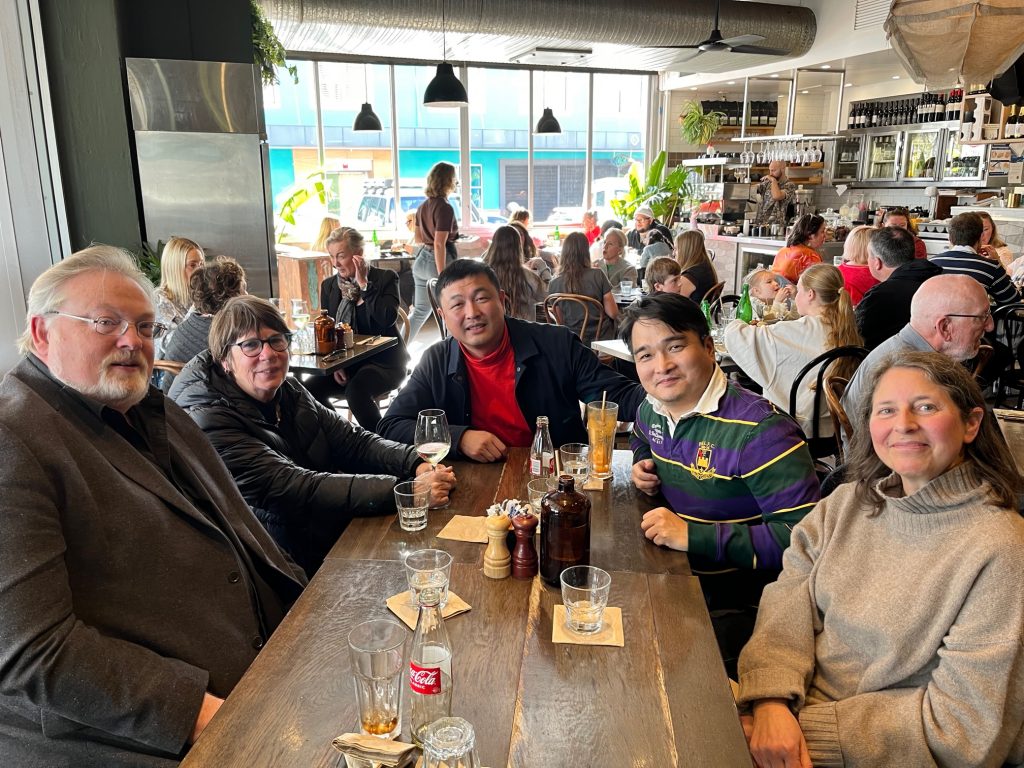
Lee and Oswald have collaborated in the fields of design computing and design cognition, since 2011 at Newcastle.
We work with industry, community, and government clients to address complex challenges related to how people use, interact with, and respond to buildings. Our research leverages computational design tools and behavioural insights to inform more adaptive, inclusive, and responsive built environments.
Our Recent Publications
Innovation in architectural design, digital collaboration, and urban development
Lee JH; Ostwald MJ, 2024
Mathematical beauty and Palladian architecture: Measuring and comparing visual complexity and diversity, Frontiers of Architectural Research

Lee JH; Ostwald MJ; Arasteh S, 2026
Rethinking architectural design education and practice with AI: a cognitive–social–technical perspective, International Journal of Technology and Design Education
Lee JH; Ostwald MJ; Jin T, 2026
From generation to co-creation: agency and collaboration in architectural design via natural language interaction, International Journal of Design Creativity and Innovation
What our researchers are saying
Here’s what A3LAB’s people think about architectural design and practice.

Michael J. Ostwald
Scientia Professor

Beyond generating form, architectural design computing now explores how geometric structures influence the cognitive perception of aesthetic character.

Ju Hyun Lee
Associate Professor
Design practitioners need to build a remote, collaborative working platform in the new normal and a trust network with all their stakeholders in the rapid digital transformation.
Michael J. Dawes
Post-doc Fellow
Integrating cognitive science, cultural analysis, and even AI, architectural design computing is reshaping how we perceive and design aesthetic experience in the built environment.

Samaneh Arasteh
Research Assistant
As computational tools embed deeper into design collaboration, the cognitive processes of perceiving, analysing, and generating adaptive interventions are being redefined.
Discover how our research ideas can take shape and create real-world impact.
Welcome to our latest ARC Workshops — where design thinking meets digital innovation. Explore new ideas, project updates, and the evolving ways we’re applying design computing and cognition to real-world challenges.

150+ Empirical Tests
20+ Design Experiments
50+ Interviews